
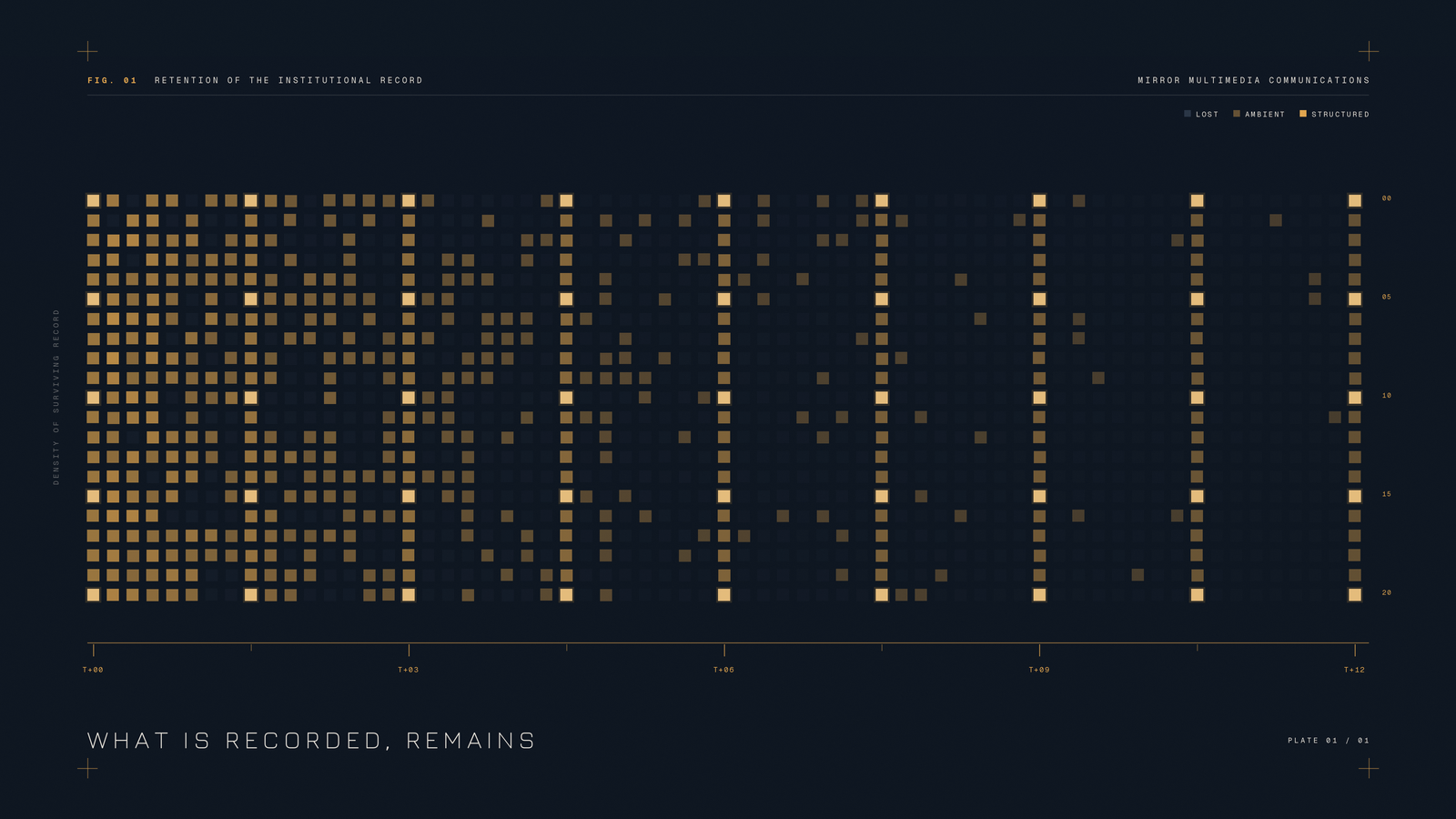
Every institution eventually faces the same quiet problem. A programme ends. The team that ran it moves on. Leadership changes. Five years later, someone needs to show what that work achieved — to a donor, a board, a partner, a new cohort of staff — and what they find is a folder of low-resolution photos, a few scattered social posts, and a handful of people trying to remember how it actually went.
The work happened. The proof didn’t survive it.
This is not a small administrative gap. For organizations whose mandate depends on demonstrating impact, the record of the work is not separate from the work. It is what makes the work legible to everyone who wasn’t in the room.
Documentation is broader than most organisations treat it
When we say documentation, we don’t mean a report filed at the end of a funding cycle. We mean the full media record an institution generates and holds: photographs, video, interviews, captions, social posts, threads, event coverage, process footage, and the written context that makes any of it meaningful years later.
Most organisations produce all of this already. What they often lack is a system: consistent quality, proper archiving, searchable context, and a deliberate decision about what gets captured before the moment passes rather than after.
An image with no caption, no date, and no context is not documentation. It is a file. The difference between the two is whether anyone can use it in five years without calling the person who took it.
What this makes possible
Institutions that treat their media record as infrastructure can do things others cannot. They can show a funder exactly what a programme looked like on the ground, not just what a spreadsheet reported. They can onboard new staff into a decade of institutional context rather than a handbook. They can defend their track record with evidence. They can tell the story of a technology, an innovation, or a service without reconstructing it from memory.
They can also do something more basic: continue. When the founder leaves, when the country director rotates out, when the implementing partner changes, the vision does not have to be re-explained from scratch. It is already recorded, in a form the next team can actually use.
Why it matters who does the work
At Mirror Multimedia Communications, we have worked with organizations including but not limited to Africa CDC, Switzaland Embassy, the ILO, AfriLabs, and the Malala Fund — institutions whose work is scrutinized, cited, and expected to hold up over time.
That kind of work demands more than someone with a good camera. It requires understanding what an institution will need to prove three years from now, knowing which moment in a five-day convening actually carries the story, and building an archive that a communications officer who has not yet been hired will be able to navigate.
Documentation treated as an afterthought produces files. Documentation treated as infrastructure produces institutional memory.
Working with us
We document institutional work as it happens and build it into something durable: photography and film that meets publication standard, interviews and process coverage captured while the context is still live, social and editorial content that carries the work beyond the room, and archives structured so that the material remains findable and usable long after the project closes.
Stay in the loop- get occasional updates from Mirror Multimedia Communications on new work and case studies.